Types
Generaledit
The general higher education and training that takes place in a university, college, or Institute of technology usually includes significant theoretical and abstract elements, as well as applied aspects (although limited offerings of internships or SURF programs attempt to provide practical applications). In contrast, the vocational higher education and training that takes place at vocational universities and schools usually concentrates on practical applications, with very little theory.
In addition, professional-level education is always included within Higher Education, and usually in graduate schools since many postgraduate academic disciplines are both vocationally, professionally, and theoretically/research oriented, such as in the law, medicine, pharmacy, dentistry, and veterinary medicine. A basic requirement for entry into these graduate-level programs is almost always a bachelor's degree, although alternative means of obtaining entry into such programs may be available at some universities. Requirements for admission to such high-level graduate programs is extremely competitive, and admitted students are expected to perform well.
When employers in any profession consider hiring a college graduate, they are looking for evidence of critical thinking, analytical reasoning skills, teamworking skills, information literacy, ethical judgment, decision-making skills, communication skills (using both text and speech), problem solving skills, and a wide knowledge of liberal arts and sciences. However, most employers consider the average graduate to be more or less deficient in all of these areas.
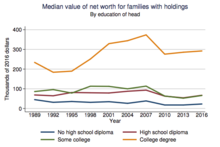
In the United States, there are large differences in wages and employment associated with different degrees. Medical doctors and lawyers are generally the highest paid workers, and have among the lowest unemployment rates. Among undergraduate fields of study, science, technology, engineering, math, and business generally offer the highest wages and best chances of employment, while education, communication, and liberal arts degrees generally offer lower wages and a lower likelihood of employment.
Liberal artsedit
Academic areas that are included within the liberal arts include great books, history, languages including English, linguistics, literature, mathematics, music, philosophy, political science, psychology, religious studies, science, environmental science, sociology and theater.
Engineeringedit
Teaching engineering is teaching the application of scientific, economic, social, and practical knowledge in order to design, build, maintain, and improve structures, machines, devices, systems, materials and processes. It may encompass using insights to conceive, model and scale an appropriate solution to a problem or objective. The discipline of engineering is extremely broad, and encompasses a range of more specialized fields of engineering, each with a more specific emphasis on particular areas of technology and types of application. Engineering disciplines include aerospace, biological, civil, chemical, computer, electrical, industrial and mechanical.
Performing artsedit
The performing arts differ from the plastic arts or visual arts, insofar as the former uses the artist's own body, face and presence as a medium; the latter uses materials such as clay, metal or paint, which can be molded or transformed to create a work of art.
Performing arts institutions include circus schools, dance schools, drama schools and music schools.
Plastic or visual artsedit
The plastic arts or visual arts are a class of art forms, that involve the use of materials, that can be moulded or modulated in some way, often in three dimensions. Examples are painting, sculpture, and drawing.
Higher educational institutions in these arts include film schools and art schools.
Vocationaledit
Higher vocational education and training takes place at the non-university tertiary level. Such education combines teaching of both practical skills and theoretical expertise. Higher education differs from other forms of post-secondary education such as that offered by institutions of vocational education, which are more colloquially known as trade schools. Higher vocational education might be contrasted with education in a usually broader scientific field, which might concentrate on theory and abstract conceptual knowledge.
Professional higher educationedit
This describes a distinct form of higher education that offers a particularly intense integration with the world of work in all its aspects (including teaching, learning, research and governance) and at all levels of the overarching Qualifications Framework of the European Higher Education Area. Its function is to diversify learning opportunities, enhance employability, offer qualifications and stimulate innovation, for the benefit of learners and society.
The intensity of integration with the world of work (which includes enterprise, civil society and the public sector) is manifested by a strong focus on application of learning. This approach involves combining phases of work and study, a concern for employability, cooperation with employers, the use of practice-relevant knowledge and use-inspired research.
Examples of providers of professional higher education may include graduate colleges of architecture, business, journalism, law, library science, optometry, pharmacy, public policy, human medicine, professional engineering, podiatric medicine, scientific dentistry, K-12 education, and veterinary medicine.
Statisticsedit
A 2014 report by the Organisation for Economic Co-operation and Development states that by 2014, 84 percent of young people were completing upper secondary education over their lifetimes, in high-income countries. Tertiary-educated individuals were earning twice as much as median workers. In contrast to historical trends in education, young women were more likely to complete upper secondary education than young men. Additionally, access to education was expanding and growth in the number of people receiving university education was rising sharply. By 2014, close to 40 percent of people aged 25–34 (and around 25 percent of those aged 55–64), were being educated at university.
Recognition of studiesedit
The Lisbon Recognition Convention stipulates that degrees and periods of study must be recognised in all of the Signatory Parties of the Convention.


Comments
Post a Comment